
Last Updated: November 2026
You’ve landed a teaching job in Da Nang, or your family is finally settling an estate in Ho Chi Minh City. Then someone hands you a checklist that still says “embassy legalization,” and you start counting the weeks and fees between you and Vietnam.
Here’s the good news. If you’re working out how to apostille US documents for Vietnam, the process got much shorter on 11 September 2026, when the Hague Apostille Convention entered into force for Vietnam. Most U.S. public documents now need one certificate, the apostille, instead of a multi-step legalization chain.
This guide shows you what changed, who issues your apostille, what it costs as of November 2026, why you still need a Vietnamese translation, and the few cases where legalization still applies.
Key Takeaways
- Since 11 September 2026, a single apostille replaces Vietnamese embassy legalization for U.S. public documents covered by the Apostille Convention.
- State records get their apostille from the issuing state’s Secretary of State, while federal records such as FBI background checks go to the U.S. Department of State.
- An apostille doesn’t translate anything: Vietnam still requires a Vietnamese translation that is notarized or certified under Vietnamese law.
Does Vietnam Accept Apostilles Now?
Quick answer: Yes. Since 11 September 2026, Vietnam accepts apostilles on U.S. public documents. You get the apostille from the Secretary of State of the state that issued the document, or from the U.S. Department of State for federal records. No embassy step is needed, but a Vietnamese translation still is.
Vietnam deposited its accession to the Convention on 31 December 2025, and it took effect on 11 September 2026, according to the Hague Conference (HCCH) and the Embassy of Viet Nam’s official notice. From that date, the embassy in Washington, D.C. stopped accepting legalization requests for U.S. public documents covered by the Convention.
What does that mean for you? In the embassy’s words, a public document bearing a valid apostille may be used in Vietnam “without any further certification.” Vietnam now stands alongside the other Hague Apostille Convention countries that accept apostilles.
And no, the United States isn’t one of the exceptions. As of November 2026, the embassy names Germany, Austria and the Czech Republic among the states where the Convention doesn’t apply with Vietnam, plus Thailand until 28 February 2027.
What Changed for U.S. Documents on 11 September 2026
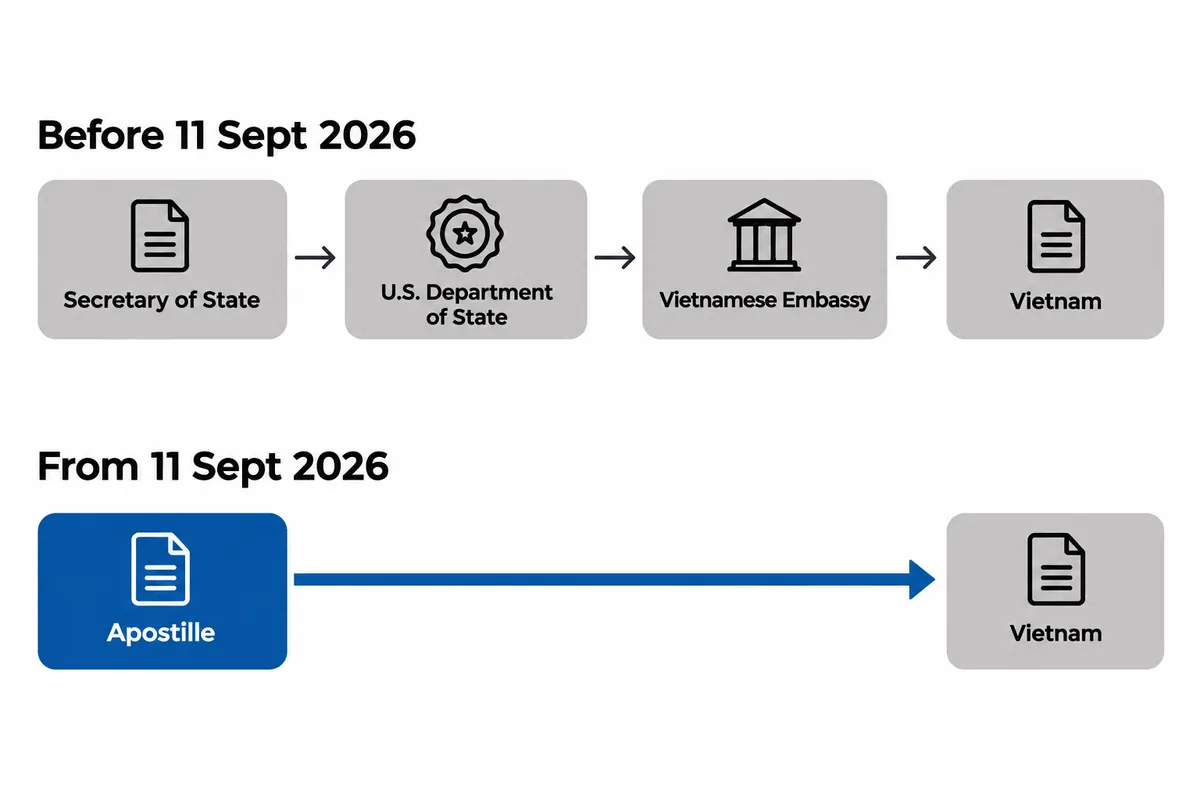
Before the switch, a U.S. document for Vietnam went through consular legalization. That meant state certification, U.S. Department of State authentication in many cases, and then a final stamp from the Vietnamese embassy or a consulate. Every link in that chain added time, fees and another chance of rejection.
Now the chain is one step long for most documents. Here’s how the two routes compare.
| Old route: consular legalization | New route: apostille | |
|---|---|---|
| State document (birth, marriage, notarized papers) | State certification, often federal authentication, then the Vietnamese embassy | Secretary of State apostille only |
| Federal document (FBI check, naturalization certificate) | U.S. Department of State authentication, then the Vietnamese embassy | U.S. Department of State apostille only |
| Vietnamese embassy step | Required | None for covered public documents |
| Vietnamese translation | Required | Still required |
| Commercial or customs documents | Legalization | Still legalization |
Here’s the part most guides skip. Apostilles issued by U.S. authorities before 11 September 2026 are also accepted, and documents already legalized through Vietnamese consular channels before that date stay valid. You don’t need to redo either one.
Federal vs State Apostille for Vietnam: Who Issues Yours?
The apostille always comes from the U.S. authority behind the signature on your document, never from Vietnam. The embassy itself tells applicants to contact the Secretary of State or the authority for the place where the document was issued.
- State documents go to the Secretary of State of the issuing state: birth, marriage and death certificates, divorce decrees, state court records, and anything signed by a notary public, such as a power of attorney or an affidavit.
- Federal documents go to the U.S. Department of State Office of Authentications: FBI background checks, certificates of naturalization, IRS Form 6166 tax residency letters and other records signed by a federal official.
Mixing these up is one of the most common reasons a file comes back unprocessed. If you’re not sure where yours belongs, look at who signed it: a federal official’s signature means a federal apostille.
How to Apostille US Documents for Vietnam, Step by Step
Most people miss this: the order of the steps matters as much as the steps themselves. Follow this sequence and you’ll sidestep the rejections we see most often.
- Confirm what the Vietnamese office wants. Ask the employer, school, ward office or immigration desk which documents it needs, how recent they must be, and whether it wants originals.
- Get the right version of each document. Vital records need a certified copy from the issuing office, not a photocopy. Private papers, like an affidavit or a power of attorney, must be signed in front of a notary.
- Send it to the correct authority. State and notarized documents go to the issuing state’s Secretary of State. Federal records go to the U.S. Department of State with Form DS-4194, listing Vietnam as the country of use.
- Never notarize a federal original. The State Department warns that a federal document is no longer valid for its apostille once it has been notarized.
- Keep the apostille attached. Don’t unstaple, re-order or laminate the packet once it comes back.
- Translate into Vietnamese after the apostille. Have the translation notarized or certified under Vietnamese law, and ask whether the office wants the apostille page translated too.
Each state adds its own small rules. In Oregon, for example, the school registrar signs a statement certifying a transcript or diploma and has it notarized before the Secretary of State adds the apostille. That’s why we check every document before it’s submitted.
Not sure which route your document needs? Upload a scan through our apostille services and the Oregon Apostille Hub team will confirm the right path to Vietnam before you mail anything.
Apostille for Vietnam Cost (as of November 2026)
Dropping the embassy step removes a whole layer of fees. What’s left is the government apostille fee and, if you use a service, the service fee.
| Item | Cost | What it covers |
|---|---|---|
| U.S. Department of State apostille | $20 per document (nonrefundable) | Federal records such as FBI checks. Processed within 5 weeks by mail, or within 7 business days by walk-in drop-off in Washington, D.C. |
| Oregon Apostille Hub Standard | $125 + govt fees | Personal and business documents, 4 to 14 business days |
| Oregon Apostille Hub Rush | $155 + govt fees | Personal and business documents, 1 to 3 business days (not available for federal documents) |
| Oregon Apostille Hub Same Day | $255 + govt fees | Personal and business documents, 24 hours for eligible documents (not available for federal documents) |
The federal fee and processing times come from the U.S. Department of State’s authentication services page, checked in November 2026. State fees vary by state, and translation is a separate cost set by your translator.
When you work with us, your quote covers our service fee, the government apostille fee, return shipping and any required notarization. The price you’re quoted is the price you pay.
Vietnamese Translation After the Apostille
Let’s be honest, this is where many files stall. An apostille confirms the signature, the signer’s capacity and the seal on your document. It doesn’t certify the content, and it doesn’t translate a single word.
The Embassy of Viet Nam is clear on this point. When a document isn’t drawn up in Vietnamese, you need a Vietnamese translation, notarized or certified in accordance with Vietnamese law. Because the rule points to Vietnamese law, many applicants have the translation done and certified in Vietnam once the apostille is attached.
Ask the receiving office how it wants the translation certified before you pay anyone. For more on sequencing, see our guide on whether translation comes before or after an apostille.
When Vietnam Still Requires Legalization
The apostille covers most documents, but not all of them. As of November 2026, the embassy lists these cases where consular legalization continues:
- Administrative documents dealing directly with commercial or customs operations
- Documents executed by diplomatic or consular agents
- Documents from states where the Convention isn’t in force with Vietnam (this doesn’t affect U.S. documents)
Whether a document counts as a public document under the Convention depends on the law of the place where it was executed. So if you’re shipping trade paperwork, such as a commercial invoice or a certificate of origin, confirm the route before you order an apostille.
Our step-by-step guide to legalizing U.S. documents for non-Hague countries explains how the longer chain works. When a Vietnam document still needs embassy legalization, we handle it through our D.C. processing partners.
Timing Your Vietnam Documents
A clean apostille can still fail if the document is too old. Vietnamese offices often set age limits, especially on police checks. For work permits, Vietnam’s Decree 219/2025/ND-CP asks for a criminal record issued no more than six months before the employer files the dossier.
So work backwards from the filing date. Federal apostilles by mail can take up to five weeks at the State Department, so order your FBI Identity History Summary once the job offer is firm, then move it straight to apostille and translation.
Vital records like birth and marriage certificates don’t expire, but some offices prefer recently issued certified copies. Ask before you order.
Common Mistakes to Avoid
Paying for embassy legalization you no longer need. Some quotes still include a Vietnamese embassy step for U.S. public documents. Since 11 September 2026, that step is gone for documents covered by the Convention.
Sending a federal document to a state office. A Secretary of State has no authority over an FBI check. Federal records go only to the U.S. Department of State.
Using a photocopy of a vital record. Apostille offices need an original certified copy from the vital records office. A home photocopy won’t qualify.
Translating before the apostille. The translation should match the finished packet. Get the apostille first, then translate and certify under Vietnamese law.
Letting the FBI check go stale. A work permit file needs a recent police check. If your start date slips, confirm the report will still be under six months old on the filing date.
Assuming trade documents qualify. Commercial and customs paperwork can fall outside the Convention. Confirm the route before you pay for an apostille.
Frequently Asked Questions
Does Vietnam accept apostilles from the United States?
Yes. Since 11 September 2026, Vietnam accepts U.S. apostilles on public documents covered by the Hague Apostille Convention, with no embassy legalization needed.
Do I still need Vietnamese embassy legalization for U.S. documents?
Not for covered public documents. The embassy stopped legalizing them on 11 September 2026. Commercial or customs documents may still need legalization.
Who issues an apostille for documents going to Vietnam?
The Secretary of State of the issuing state handles state and notarized documents. The U.S. Department of State handles federal records like FBI checks.
How long does an apostille for Vietnam take?
It depends on the issuer. Our state service takes 24 hours to 14 business days by tier. Federal apostilles take up to 5 weeks by mail at the State Department.
Do apostilled documents for Vietnam need a Vietnamese translation?
Yes, if the document isn’t in Vietnamese. The translation must be notarized or certified under Vietnamese law. Ask the receiving office how it wants this done.
Are documents legalized before 11 September 2026 still valid in Vietnam?
Yes. Documents legalized through Vietnamese consular channels before that date remain valid, and you don’t need to repeat the process with an apostille.
Can I send a scanned copy of an apostilled document to Vietnam?
Plan on the original. The apostille is attached to the physical document, so keep the packet intact and send the original unless the office says otherwise.
Do I need to be in the U.S. to apostille documents for Vietnam?
No. The whole process can run by mail. Oregon Apostille Hub ships apostilled documents back via FedEx or DHL anywhere in the world, including Vietnam.
How much does a federal apostille for Vietnam cost?
As of November 2026, the U.S. Department of State charges $20 per document, nonrefundable. Service fees, if you use a provider, are added on top.
Can I apostille a commercial invoice for use in Vietnam?
Maybe not. Documents dealing directly with commercial or customs operations may still need embassy legalization. Confirm the route before you order.
Conclusion
Learning how to apostille US documents for Vietnam is far simpler since the Convention took effect. Keep these points in mind:
- One apostille now replaces embassy legalization for covered U.S. public documents.
- State records go to the issuing state’s Secretary of State, and federal records go to the U.S. Department of State.
- A Vietnamese translation is still required, certified under Vietnamese law.
- Commercial and customs documents may still need the longer legalization route.
Get the order right, and your documents can reach Vietnam with far fewer steps, fees and delays.
Ready to send your documents to Vietnam? Contact Oregon Apostille Hub or call (971) 708-3000, and we’ll handle the apostille from our Lake Oswego office and ship it back to you anywhere in the world.
