

The debate between apostille and legalization has gained attention since Canada joined the Hague Apostille Convention on January 11, 2024. Document preparation for international use requires a clear understanding of these two certification methods to avoid delays and rejections. More than 124 countries, including Canada, now use the apostille process. This system provides a simple one-step authentication for documents used in Hague Convention countries. Countries that don’t participate in the Hague Apostille Convention require document legalization through a more complex multi-step verification process.
Your choice between apostille and authentication can substantially affect how officials process your marriage certificate, educational documents, or business contracts. The 1961 Hague Convention made document processing easier by removing the need for embassy or consulate legalization among member countries. Apostille and authentication serve different purposes – apostille works for Hague member countries, while non-member nations require authentication and legalization. This piece breaks down document legalization and apostille in detail to help you choose the right process for your needs.
Understanding Apostille and Legalization
People need to verify documents that cross international borders. Anyone working with international paperwork should know the difference between apostille and legalization.
What is an Apostille and at the time is it used?
An apostille acts as a certificate that proves where a public document came from. This special certificate helps verify three important things: the signature’s authenticity, the document signer’s role, and any seal or stamp on the document. The apostille does not verify the document’s actual content.
Only countries that are part of the 1961 Hague Apostille Convention use this simple verification process. More than 120 countries now accept apostilles worldwide. Birth certificates, marriage certificates, diplomas, academic transcripts, business contracts, and powers of attorney often need apostilles.
What is Document Legalization and at the time is it required?
Document legalization shares the same basic goal as an apostille but needs more steps. The process verifies a foreign public document by checking the signature’s authenticity and the signing authority’s legitimacy.
Countries that haven’t signed the Hague Convention need document legalization. The process takes multiple steps, unlike the single-step apostille. You’ll need to complete these steps:
- Original notarization
- Authentication by state authorities
- The destination country’s embassy or consulate must give final approval
Hague Convention: The deciding factor
The 1961 Hague Convention reshaped the scene of international document processing with a standard way to verify documents. Member nations no longer needed legalization because of this treaty. They could use the simplified apostille process instead.
The destination country helps you decide between an apostille or legalization. Documents going to Hague Convention members need just an apostille. Non-member countries still require the complete legalization process.
Step-by-Step Process Comparison
Understanding which method works for your situation is a vital step to get your documents accepted internationally. The procedural differences between apostille and legalization make this choice significant.
Apostille Process: One-step certification
The apostille procedure is a quick way to certify documents that just needs a single step. You submit your document to a designated authority in the issuing country, which is usually a state department or foreign affairs ministry. The California Secretary of State handles these requests. The authority checks the document and adds an apostille certificate with an official seal.
You just need these four items to process an apostille:
- The original document (photocopies are rejected)
- A cover sheet showing the destination country
- Payment ($20 per apostille plus a $6 special handling fee for each public official’s signature)
- A self-addressed envelope to get your document back
Legalization Process: Multi-step verification
The legalization process has a more detailed path than apostille. This process has:
- Notarization (if required)
- State certification of the notary’s commission
- U.S. Department of State authentication
- Final verification by the embassy or consulate of the destination country
Each country can set its own rules about document submission, fees, and authentication stages. On top of that, it’s common for some embassies to ask for extra certifications beyond the standard steps.
Notarization requirements for both methods
Both apostille and legalization might need notarized documents. In spite of that, vital records from state or federal governments often skip this requirement. Original notarized documents are a must—photocopies won’t work. It’s worth mentioning that notaries can’t issue apostilles themselves.
Time and cost differences
The apostille certification is nowhere near as complex or expensive as legalization. Here’s how long it takes based on how you submit:
- Mail requests: 5+ weeks
- Walk-in service: 2-3 weeks
- Appointment (for urgent situations): Under 2 weeks
The costs are straightforward for apostilles ($20 per document in California), while legalization expenses pile up with each certification step. The legalization process takes several weeks or longer because it has multiple authentication stages.
Document Types and Country Requirements
Different types of documents need international validation. These range from personal certificates to complex business agreements. The destination country is the biggest problem in determining the right authentication method.
Common documents that need an apostille
People often just need apostilles for their personal documents. These include birth, marriage, and death certificates, among other things like divorce decrees and adoption papers. Students who apply to schools abroad usually need apostille certification for their diplomas and transcripts. Business documents like contracts, powers of attorney, and corporate bylaws also need apostilles for overseas operations.
Documents typically requiring legalization
Non-Hague countries require full legalization for immigration paperwork. The work to be done includes processing commercial invoices, certificates of incorporation, and medical records for international employment. It also involves verifying affidavits, court judgments, and notarized agreements through more thorough checks.
Examples of Hague vs non-Hague countries
Hague Convention members include Spain, France, Germany, Japan, Australia, and Italy. So, these nations only ask for an apostille. However, non-Hague countries like China, UAE, Qatar, Kuwait, and Egypt just need complete legalization procedures.
Translation and embassy-specific rules
Foreign authorities often require both apostille/legalization and certified translations. This requirement becomes essential especially when you have birth certificates, marriage licenses, academic credentials, and power of attorney documents. Each embassy might set its own unique submission requirements beyond standard procedures.
Apostille vs Legalization: Key Differences
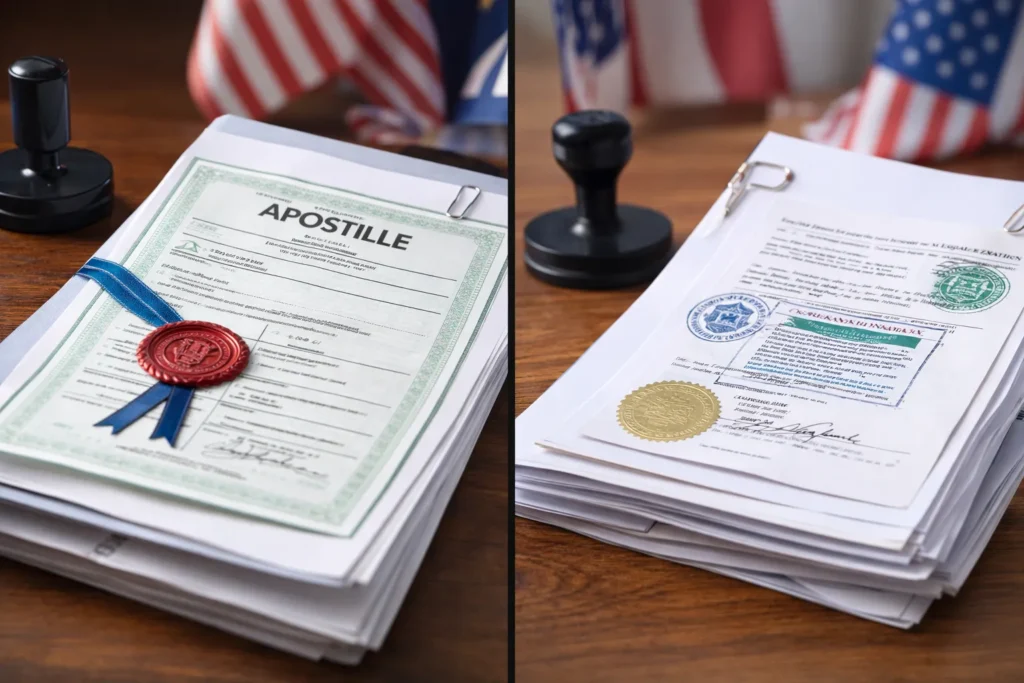
People need to know the key differences between apostille and legalization when processing international documents. Both methods authenticate documents but serve unique purposes based on international agreements.
Authentication vs Apostille: Are they interchangeable?
Many people confuse apostille and authentication, but they’re not the same thing. Member countries of the Hague Convention use apostille as a simpler form of legalization. Non-member nations need authentication that involves multiple verification steps. Both methods check if a document is genuine but don’t validate its contents.
Legal validity and recognition across countries
The apostille certificate will give immediate validity in all 125+ Hague Convention member countries. Legalized documents work only in countries where consulates have processed them. This difference guides your choice of method, and your destination country’s requirements matter more than what you prefer.
Risks of choosing the wrong method
Using the wrong authentication method can create serious problems. Your visa might get rejected, you could lose your job, face legal penalties for fraud, or damage your reputation. Wrong authentication often causes delays, rejections, or canceled applications.
Document legalization vs apostille: Summary table
| Feature | Apostille | Legalization |
| Applicable In | Hague Convention countries (125+) | Non-Hague countries |
| Process Steps | Single-step certification | Multi-step verification including embassy |
| Timeline | Typically days to weeks | Several weeks to months |
| Legal Recognition | Valid in all member countries | Valid only in the certifying country |
Comparison Table
| Aspect | Apostille | Legalization |
| Applicable Countries | Hague Convention members (125+ countries) | Non-Hague Convention countries |
| Process Steps | Single-step certification | Multiple steps (notarization, state certification, US Department of State, embassy verification) |
| Processing Timeline | Mail: 5+ weeksWalk-in: 2-3 weeksAppointment: Under 2 weeks | Several weeks or longer |
| Cost Structure | Fixed fee ($20 per document in California) | Costs add up with each certification step |
| Authority | Designated state authority (e.g., Secretary of State) | Multiple authorities including embassy/consulate |
| Legal Recognition | Accepted in all Hague member countries | Accepted only in the specific certifying country |
| Common Documents | – Birth certificates- Marriage certificates- Diplomas- Academic transcripts- Business contracts- Powers of attorney | – Immigration paperwork- Commercial invoices- Certificates of incorporation- Medical records- Affidavits- Court judgments |
| Verification Scope | Verifies signer’s signature authenticity, capacity, and seal/stamp identity | Verifies signature authenticity and signing authority legitimacy |
Conclusion
The apostille and legalization process you need depends on where your documents are going. Documents going to Hague Convention countries need the efficient apostille process. Non-member countries require a more complete legalization procedure. This choice affects your processing time, costs, and document acceptance.
Both methods check if documents are real, not what’s in them. They work quite differently though. An apostille is a one-step certification that works in all 125+ member countries right away. Legalization is nowhere near as simple. It needs multiple checks and only works in the country where an embassy or consulate processes it.
Time makes a vital difference between these options. You can get an apostille within weeks if you submit everything correctly. Legalization takes months because it has many steps. It also gets pricey – apostille fees stay the same for each document, but legalization costs add up with every check.
Picking the wrong method can cause serious trouble. Your applications might get rejected, visas denied, and you could face legal issues with wrong document authentication. Research what your destination country needs before you start either process.
Canada joining the Hague Apostille Convention shows how international paperwork keeps changing. Canadians can now use the simpler apostille process when sending documents to other member countries. In spite of that, documents going to non-member countries still need traditional legalization.
Choosing between apostille and legalization is simple but important. Your document’s destination picks the path for you, whatever you might prefer. Good research and preparation help you avoid delays and rejections that can cost you time and money.